№ 142 / 161
★ DOSSIER · 案件詳情
NASA-UAP-D5, Apollo 17 Crew Debriefing for Science, 1973
NASA-UAP-D5, Apollo 17 Crew Debriefing for Science, 1973
機關
NASA
類型
PDF 文件
日期
1973
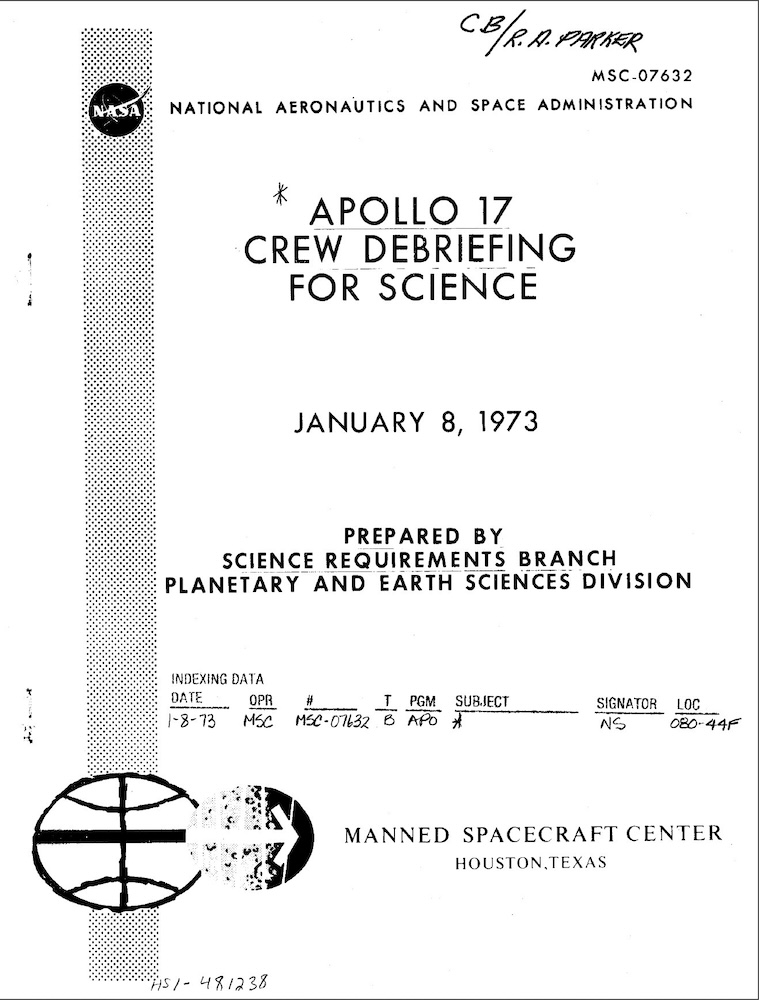
Apollo 17 was the ninth crewed U.S. mission to the Moon, and the sixth to land Astronauts on the lunar surface. This document is an excerpt from the Apollo 17 Crew Debriefing for Science on January 8, 1973, in which Dick Henry, co-investigator on the ultraviolet experiment on Apollo 17, discusses seeing results that were unexpected. • Pages 119-120. “One of the most exciting results of X-ray astronomy was the fact that an X-ray background was observed over the sky that nobody had expected, and part of this is the gamma-ray background that Dr. Trombka talked about. In the UV, nobody knows, but you never know until you look. You do have to deal with this background of stars that we know is there. So, we did look at a large number of different points at high galactic latitudes, both north and south. The spectrum that we see is above this dark count. In other words, this abnormally high dark current did not, in fact, interfere with that experiment. The spectrum that we see looks like the spectrum of the hot star; however, we know that there were no hot stars within our field of view. Therefore, the most conservative interpretation, I think, is that what we're seeing is light from hot stars in the galactic plane going up out of the plane and reflecting off interstellar dust. There are certain characteristics of the spectrum, though, that don't fit that theory, and it's at least possible that this is extragalactic radiation. I'm looking forward very much to the detailed computer study of this, but it's going to take a long time.”
查看英文原文摘要
Apollo 17 was the ninth crewed U.S. mission to the Moon, and the sixth to land Astronauts on the lunar surface. This document is an excerpt from the Apollo 17 Crew Debriefing for Science on January 8, 1973, in which Dick Henry, co-investigator on the ultraviolet experiment on Apollo 17, discusses seeing results that were unexpected. • Pages 119-120. “One of the most exciting results of X-ray astronomy was the fact that an X-ray background was observed over the sky that nobody had expected, and part of this is the gamma-ray background that Dr. Trombka talked about. In the UV, nobody knows, but you never know until you look. You do have to deal with this background of stars that we know is there. So, we did look at a large number of different points at high galactic latitudes, both north and south. The spectrum that we see is above this dark count. In other words, this abnormally high dark current did not, in fact, interfere with that experiment. The spectrum that we see looks like the spectrum of the hot star; however, we know that there were no hot stars within our field of view. Therefore, the most conservative interpretation, I think, is that what we're seeing is light from hot stars in the galactic plane going up out of the plane and reflecting off interstellar dust. There are certain characteristics of the spectrum, though, that don't fit that theory, and it's at least possible that this is extragalactic radiation. I'm looking forward very much to the detailed computer study of this, but it's going to take a long time.”