№ 151 / 161
★ DOSSIER · 案件詳情
Außenministerium der USA UAP-Kabel 1, Papua-Neuguinea, 28. Januar 1985
State Department UAP Cable 1, Papua New Guinea, January 28, 1985
機關
美國國務院
類型
PDF 文件
日期
1/24/85
地點
Papua New Guinea
★ FULL TEXT · 全文翻譯已備
閱讀完整翻譯(共 3 頁) →
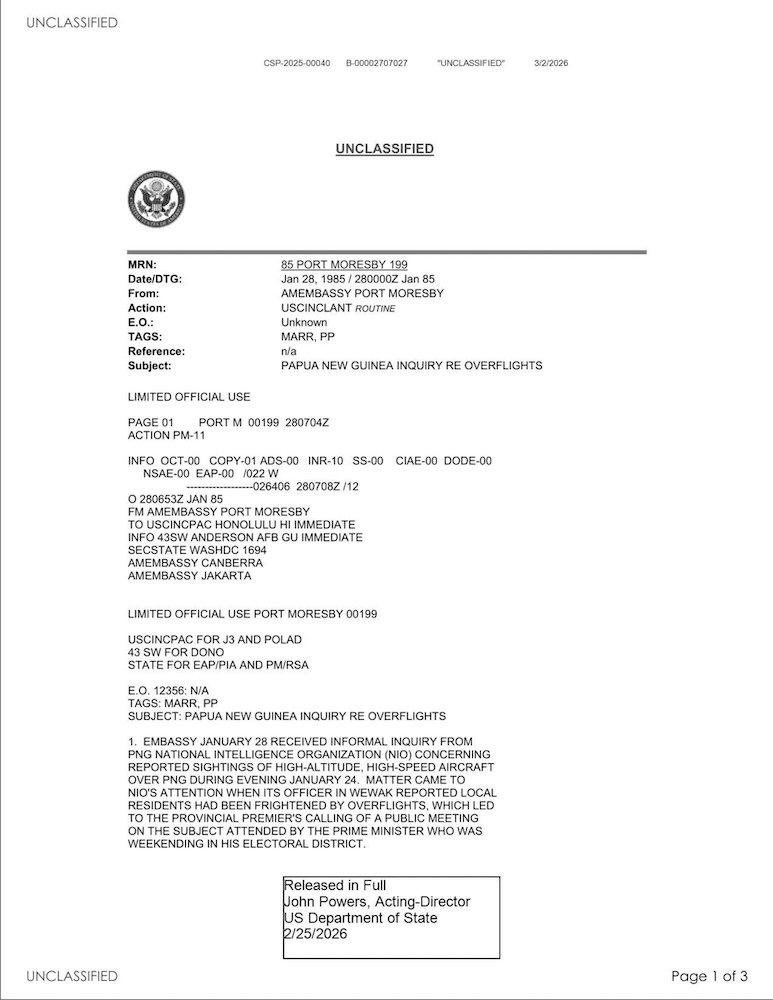
Dieses Dokument ist ein Diplomatisches Telegramm des Außenministeriums der USA von der US-Botschaft in Port Moresby, Papua-Neuguinea an die USCINCPAC (Indopazifik-Kommando der USA) in Honolulu, Hawaii vom 28. Januar 1985. Das Telegramm berichtet, dass die US-Botschaft in Papua-Neuguinea eine Anfrage von den Geheimdiensten des Gastlandes erhielt, bezüglich Meldungen von Hochflug-, Hochgeschwindigkeitsflugzeugen im Luftraum Papua-Neuguineas am Abend des 24. Januar 1985. Das Telegramm bezeichnet einen Vertreter der lokalen Geheimdienste als „NIO" oder Nationaler Geheimdienst-Offizier (National Intelligence Officer) durchgehend. Der NIO teilte dem US-Diplomatischen Personal mit, dass Bewohner durch Überflüge „verängstigt" worden seien, „was zur Einberufung einer öffentlichen Versammlung durch den Premierminister der Provinz zu diesem Thema führte." Der NIO gab auch an, dass es „verschiedene Meldungen unidentifizierter Luftphänomene in der Nacht des 24. Januar gab, einschließlich schnell beweglicher Objekte mit Lichtern, Kondensstreifen und Lärm." Der NIO bewertete diese Meldungen als glaubwürdig basierend auf der Aussage eines Air-Niugini-Piloten, der sagte, dass sein Radar „Flugzeuge erfasst hatte, die in südnördlicher Richtung in großer Höhe und großer Geschwindigkeit flogen." Das Telegramm endet mit der Charakterisierung der vom NIO bereitgestellten Informationen als „sehr fragmentarisch." Es forderte auch Klarstellung von INDOPACOM auf die Anwesenheit oder Abwesenheit von US-Militärflugzeugen im Luftraum Papua-Neuguineas in der fraglichen Nacht.
查看英文原文摘要
This document is a U.S. Department of State diplomatic cable from the U.S. Embassy in Port Moresby, Papua New Guinea to USCINCPAC (United States Indo-Pacific Command) at Honolulu, HI on January 28, 1985. The cable reports that the U.S. Embassy to Papua New Guinea received an inquiry from the host nation’s intelligence services regarding reports of high-altitude, high-speed aircraft in Papua New Guinean airspace on the evening of January 24, 1985. The cable refers to a representative of the local intelligence services as “NIO,” or National Intelligence Officer, throughout. The NIO relayed to U.S. diplomatic personnel that residents had been “frightened by overflights, which led to the provincial premier’s calling of a public meeting on the subject.” The NIO also stated there had been “various reports of unidentified aerial phenomena the night of January 24, including fast-moving objects with lights, contrails, and noise.” The NIO assessed these reports as credible based upon the testimony of an Air Niugini pilot who said that their radar had “picked up aircraft flying south to north at high altitude and high speed.” The cable concludes by characterizing the information provided by the NIO as “very sketchy.” It also sought clarification from U.S. INDOPACOM on the presence or absence of U.S. military aircraft within Papua New Guinean airspace on the night in question.