№ 142 / 161
★ DOSSIER · 案件詳情
NASA-UAP-D5, Apollo 17 Besatzungs-Debriefing für Wissenschaft, 1973
NASA-UAP-D5, Apollo 17 Crew Debriefing for Science, 1973
機關
NASA
類型
PDF 文件
日期
1973
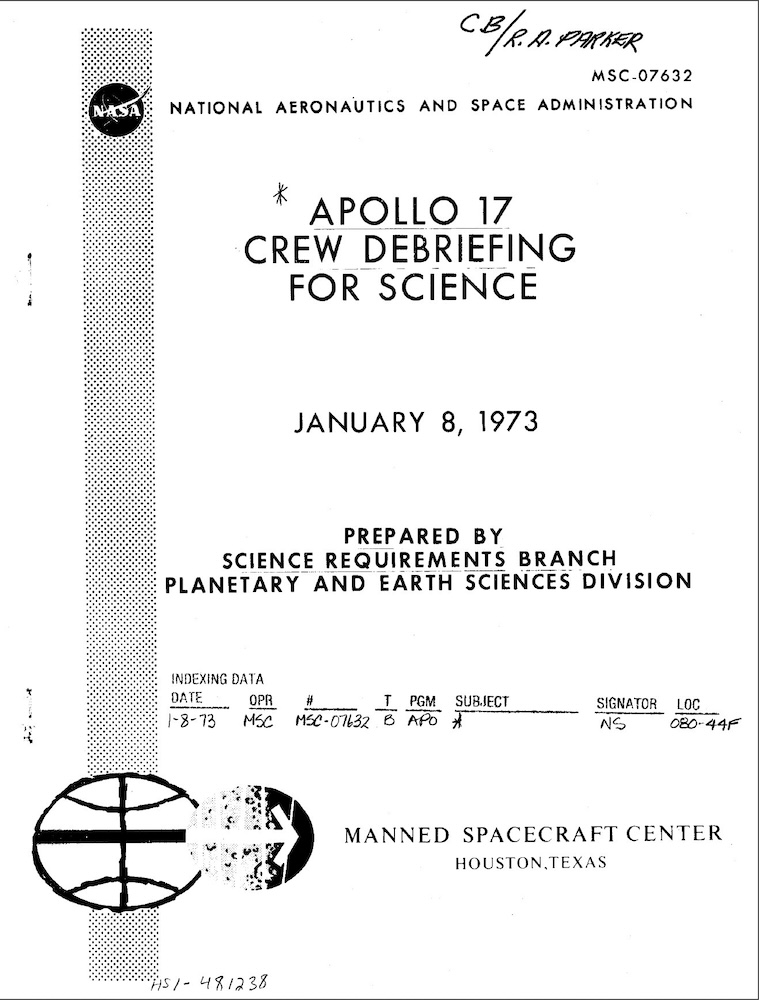
Apollo 17 war die neunte bemannte US-Mission zum Mond und die sechste, die Astronauten auf der Mondoberfläche landete. Dieses Dokument ist ein Auszug aus der Apollo 17 Crew Debriefing for Science vom 8. Januar 1973, in dem Dick Henry, Co-Investigator beim Ultraviolett-Experiment auf Apollo 17, die Diskussion unerwarteter Ergebnisse führt. • Seiten 119–120. „Eines der aufregendsten Ergebnisse der Röntgenastronomie war die Tatsache, dass eine Röntgenhintergrundstrahlung über dem Himmel beobachtet wurde, die niemand erwartet hatte, und ein Teil davon ist die Gammastrahlen-Hintergrundstrahlung, von der Dr. Trombka sprach. Im UV weiß niemand, aber man weiß nie, bis man hinschaut. Man muss sich tatsächlich mit diesem Hintergrund von Sternen befassen, von dem wir wissen, dass er vorhanden ist. Wir haben also eine große Anzahl verschiedener Punkte bei hohen galaktischen Breiten beobachtet, sowohl nördlich als auch südlich. Das Spektrum, das wir sehen, liegt über diesem Dark Count. Mit anderen Worten: Dieser abnormal hohe Dunkelstrom hat das Experiment tatsächlich nicht beeinträchtigt. Das Spektrum, das wir sehen, sieht wie das Spektrum eines heißen Sterns aus; wir wissen jedoch, dass es in unserem Sichtfeld keine heißen Sterne gab. Daher ist meiner Meinung nach die konservativste Interpretation, dass wir Licht von heißen Sternen in der galaktischen Ebene sehen, das aus der Ebene aufsteigt und von interstellarem Staub reflektiert wird. Es gibt jedoch bestimmte Merkmale des Spektrums, die diese Theorie nicht erfüllen, und es ist zumindest möglich, dass dies extragalaktische Strahlung ist. Ich freue mich sehr auf die detaillierte Computerstudie hierzu, aber das wird lange dauern."
查看英文原文摘要
Apollo 17 was the ninth crewed U.S. mission to the Moon, and the sixth to land Astronauts on the lunar surface. This document is an excerpt from the Apollo 17 Crew Debriefing for Science on January 8, 1973, in which Dick Henry, co-investigator on the ultraviolet experiment on Apollo 17, discusses seeing results that were unexpected. • Pages 119-120. “One of the most exciting results of X-ray astronomy was the fact that an X-ray background was observed over the sky that nobody had expected, and part of this is the gamma-ray background that Dr. Trombka talked about. In the UV, nobody knows, but you never know until you look. You do have to deal with this background of stars that we know is there. So, we did look at a large number of different points at high galactic latitudes, both north and south. The spectrum that we see is above this dark count. In other words, this abnormally high dark current did not, in fact, interfere with that experiment. The spectrum that we see looks like the spectrum of the hot star; however, we know that there were no hot stars within our field of view. Therefore, the most conservative interpretation, I think, is that what we're seeing is light from hot stars in the galactic plane going up out of the plane and reflecting off interstellar dust. There are certain characteristics of the spectrum, though, that don't fit that theory, and it's at least possible that this is extragalactic radiation. I'm looking forward very much to the detailed computer study of this, but it's going to take a long time.”