№ 140 / 161
★ DOSSIER · 案件詳情
NASA-UAP-D2, Apollo 17 Transkript, 1972
NASA-UAP-D2, Apollo 17 Transcript, 1972
機關
NASA
類型
PDF 文件
日期
1972
地點
Moon
★ FULL TEXT · 全文翻譯已備
閱讀完整翻譯(共 16 頁) →
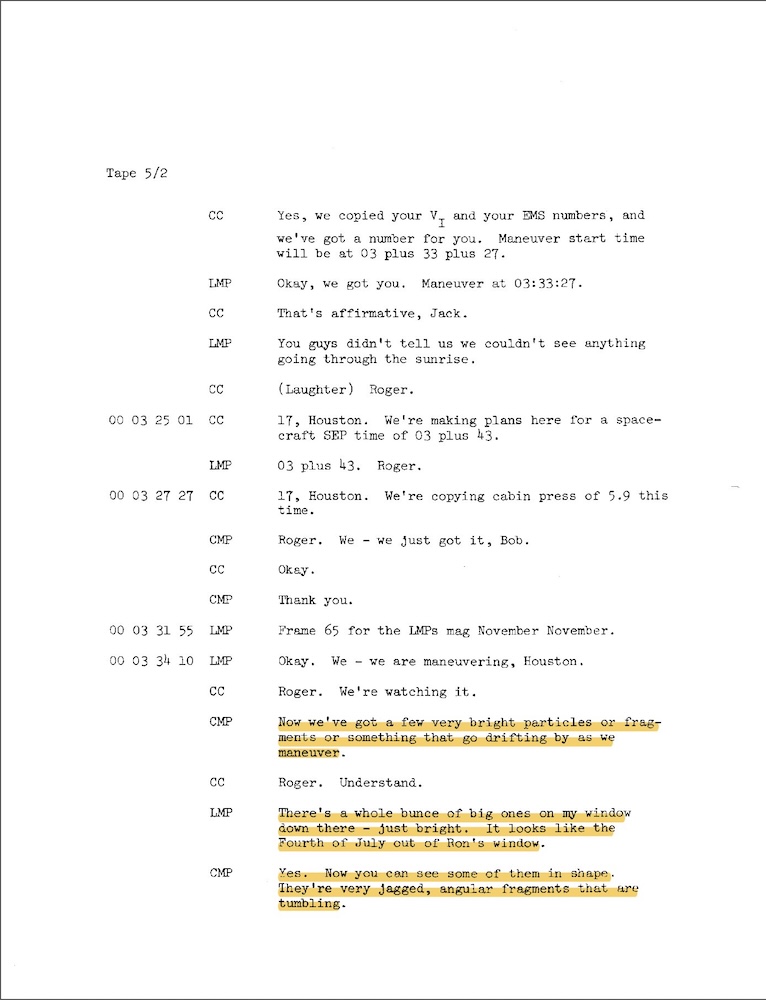
Apollo 17 war die neunte bemannte US-Mission zum Mond und die sechste, die Astronauten auf der Mondoberfläche landete. Dieses Dokument ist ein Auszug aus der Apollo 17 Technical Air-to-Ground Voice Transcription vom Dezember 1972 und hebt drei Zeiträume hervor, in denen Astronauten die Beobachtung unidentifizierter Phänomene meldeten: ein neunminütiger Zeitraum am ersten Tag, ein dreisstündiger Zeitraum am zweiten Tag und ein sechsminütiger Zeitraum am dritten Tag. • Day 00, Hour 03, Minute 34, Second 10 through Day 00, Hour 03, Minute 42, Second 29: ○ Command Module Pilot (CMP), Ronald Evans, meldete die Beobachtung von „sehr hellen Partikeln oder Fragmenten", die in der Nähe des Raumfahrzeugs während dessen Manövers trieben und „tummelten". Lunar Module Pilot (LMP), Harrison „Jack" Schmitt, beschrieb das Phänomen als „wie am Unabhängigkeitstag". Die Astronauten spekulierten, dass das Phänomen auf Eis- oder Lackfragmente zurückzuführen sein könnte, die sich von einer abgetrennten Komponente des Raumfahrzeugs (S-IVB) ablösten, charakterisierten diese Bewertung aber als „Schätzung ins Blaue hinein". • Day 02, Hour 18, Minute 42, Second 34 through Day 02, Hour 21, Minute 07, Second 05: ○ Missionskommandant Eugene A. Cernan meldete Schwierigkeiten beim Einschlafen und beschrieb, dass er „einige Sätze von Streifen" beobachtet hatte. Er beschrieb auch ein intensives Licht, das zwischen seinen Augen blitzte, und verglich seine Intensität mit der eines Zugscheinwerfers, charakterisierte es als „beeindruckend". In den nächsten drei Stunden beschrieb Cernan die Beobachtung mehrerer blitzender, rotierender Phänomene, die er als physikalische Objekte im Weltall eher als als rein optisches Phänomen einordnete. LMP Schmitt meldete ebenfalls die Beobachtung ähnlicher Phänomene, ordnete die Quelle seiner Beobachtung aber wieder einer abgetrennten Raketenstufe (S-IVB) zu. Um 02:20:55:22 meldete Cernan die Beobachtung von zwei zusätzlichen entfernten blitzenden Objekten, ordnete sie aber als Spacecraft/Lunar Module Adapter-Paneele (SLA-Panel), eine weitere abgetrennte Komponente der Saturn-V-Rakete, ein. • Day 03, Hour 15, Minute 33, Second 25 through Day 03, Hour 15, Minute 39, Second 46: ○ Um 03:15:38:09 rief LMP Schmitt aus, dass er einen Blitz auf der Mondoberfläche nördlich des Kraters Grimaldi beobachtet hatte.
查看英文原文摘要
Apollo 17 was the ninth crewed U.S. mission to the Moon, and the sixth to land astronauts on the lunar surface. This document is an excerpt from the Apollo 17 Technical Air-to-Ground Voice Transcription, December 1972, highlighting three periods in which astronauts reported observing unidentified phenomenon: a nine minute period on the first day, a three hour period on the second day, and a six minute period on the third day. • Day 00, Hour 03, Minute 34, Second 10 through Day 00, Hour 03, Minute 42, Second 29: o Command Module Pilot (CMP), Ronald Evans, reported observing “very bright particles or fragments” drifting and “tumbling” near the spacecraft as it maneuvered. Lunar Module Pilot (LMP), Harrison “Jack” Schmitt, described the phenomenon as looking “like the Fourth of July.” The astronauts speculated that the phenomenon may be attributable to ice or paint fragments dislodging from a separated component of the spacecraft (S-IVB) but characterized that assessment as a “wild guess.” • Day 02, Hour 18, Minute 42, Second 34 through Day 02, Hour 21, Minute 07, Second 05: o Mission Commander, Eugene A. Cernan, reported difficulty sleeping and described having observed “some sets of the streaks.” He also described an intense light flashing between his eyes, describing its intensity as comparable to that of a train headlight and characterizing it as “imposing.” Over the next three hours, Cernan described observing several flashing, rotating phenomenon that he assessed as corresponding to physical objects in space rather than a purely optical phenomenon. LMP Schmitt also reported observing similar phenomenon, though he again assessed the source of his observation to be a separated rocket stage (S-IVB). At 02:20:55:22, Cernan reported observing two additional distant flashing objects, though he assessed them as Spacecraft/Lunar Module Adapter panels (SLA panel), another separated component of the Saturn V rocket. • Day 03, Hour 15, Minute 33, Second 25 through Day 03, Hour 15, Minute 39, Second 46: o At 03:15:38:09, LMP Schmitt exclaimed that he had observed a flash on the lunar surface north of Grimaldi (crater).